Authors

Showing posts with label farm. Show all posts

Friday, September 25, 2015

What Activities and Events Might Drive Customers to Your Tasting Room? Part 2

By Dr Kathy Kelley--Professor of Horticultural Marketing and Business Management, Abigail Miller--Master's student in the Penn State Plant Sciences Department, and Dana Ollendyke--Extension Associate


In part 1 of this series, we discussed survey results as to what activities and events respondents had the most interest. There are also other opportunities to make connections with local restaurants, cheese mongers, bakeries, chocolatiers, etc. For example, might one (or more) of these businesses create a small tasting plate that could be included in your “premier tasting option?” Or, could it be purchased separately for visitors to enjoy along with a glass of wine they purchase and consume at your tasting room? It is likely that some of your visitors would appreciate the opportunity to try a regional cheese with your wine.


Or, you could substitute the palate-cleansing crackers you provide to each taster with a few slices of bread from a local bakery. This is another great way to cross promote with other local businesses. While in Paris this last May, I participated in two separate tasting events at O-Chateau Wine Tasting & Wine Bar (o-chateau.com). Along with a breakdown of what my tasting fee would include (five still French wines and one Champagne, a two-hour session with an English speaking sommelier, and a private tasting room for no more than 12 participants), the description also alerted me that not only would bread be included, but that I would be tasting baguettes from the bakery that supplies items for the president of France. Though some participants might not consider this as being a benefit or anything special, others might find it appealing.


With 70.2% of our participants responding that they would be interested in visiting a winery that offered “holiday events,” consider occasions that might be a good fit with your wine. Commonly celebrated holidays such as Valentine’s Day, Thanksgiving, New Years, and religious holidays might come to mind quite easily, but don’t forget local holidays or events that may appeal to your tasting room visitors. For example, the neighborhood of Bloomfield (in Pittsburgh, PA) holds an annual Italian heritage festival called “Little Italy Days” (http://littleitalydays.com). A winery tasting room could partner with a local Italian bakery to pair wines with Italian pastries.

While a “painting party/class” and “book clubs” were of less interest to our participants, it is possible that such events and activities might still be of great interest to your visitors. As with any new marketing idea or change you make, it is essential to make sure that “it” is a good fit for your business, then trial “it,” and finally evaluate “it.”

Just a few things to think about as you plan your future winery tasting room activities and events. You may want to even consider planning an event to celebrate Wine Tourism Day on November 7th (http://www.winetourismday.org). In its third year, the day is planned to encourage wine tourism businesses, including hotels and restaurants, to offer events as a way “to celebrate the importance (and fun) of wine tourism.” Another opportunity to raise your glass and celebrate!


Additional Research & Thesis Advisory Team Members:

• Jeffrey Hyde, Professor, Agricultural Economics, The Pennsylvania State University

• Denise Gardener, Extension Enologist, Department of Food Science, The Pennsylvania State University

• Brad Rickard, Assistant Professor, Charles H. Dyson School of Applied Economics and Management, Cornell University

• Ramu Govindasamy, Professor, Department of Agricultural, Food and Resource Economics, Rutgers University

• Karl Storchmann, Clinical Professor, Economics Department, New York University; Managing Editor, Journal of Wine Economics

• Rob Crassweller, Professor, Professor of Tree Fruit, The Pennsylvania State

University


The project “Developing Wine Marketing Strategies for the Mid-Atlantic Region” (GRANT 11091317) is being funded by a USDA Federal-State Marketing Improvement Program grant, whose goal is “to assist in exploring new market opportunities for U.S. food and agricultural products and to encourage research and innovation aimed at improving the efficiency and performance of the marketing system.” For more information about the program, visit http://www.ams.usda.gov.

Friday, September 11, 2015

What Activities and Events Might Drive Customers to Your Tasting Room? Part 1

By Dr Kathy Kelley--Professor of Horticultural Marketing and Business Management, Abigail Miller-- Master's student in the Penn State Plant Sciences Department, and Dana Ollendyke-- Extension Associate


In 2014, researchers at Penn State, Rutgers, Cornell, and New York University collaborated on a wine marketing study funded by the USDA. Data were collected through a 15-minute Internet survey (22-24 October 2014). Participants residing in New Jersey, New York, and Pennsylvania were screened for not being a member of the wine industry, being at least 21 years old, and for having purchased and drank wine at least once within the previous year. A total of 977 participants qualified and completed the survey.

With approximately “81% of [Pennsylvania wine] sold directly from wineries” (http://bit.ly/1LygxFl), one of the issues we investigated in last year’s survey was what a winery could offer to encourage winery tasting room visits and increase the frequency of these visits.  While, in some cases, we investigated broad categories and factors, we have plans to delve deeper in an upcoming survey to see what could motivate consumers to visit a winery tasting room and barriers survey participants feel prevents them from visiting.

Interest in winery activities and events

Today’s visitors do much more than just taste the wine at a tasting room; rather, there are opportunities to tour the vineyard and the wine-making facility, participate in classes, attend festivals, and much more (http://bit.ly/1JtOEHK).

But should a winery go through the process of planning, implementing, and evaluating an event or activity?

Data from a study conducted by researchers at Texas A&M University and Sam Houston University showed that, for Texas wineries, there was “a positive correlation between wineries that offer services such as tasting rooms and tours and gross sales… [thus] the more tourism services a winery offers, the higher their potential for gross sales” (http://bit.ly/1NSBgRx),

OK, so, with all that could be offered – what activities and/or events might garner the greatest consumer interest?

Though not an exhaustive list, we focused on activities and events that were more commonly found when we investigated wineries online and also based on popular press articles. As an example, an event that has been offered at some wineries and restaurants is a “Paint Nite,” during which attendees paint a certain picture by following an instructor while enjoying wine or other alcoholic beverages (for example, https://www.paintnite.com/). We were interested in learning if this activity appealed to our participants, and, if so, how much. Below is a table with data pertaining to the level of interest our participants expressed based on the seven activities/events that we tested.


As you can see, “tasting events,” “tour of the winery and vineyard,” and “food vendors from local restaurants,” were the three activities that had the highest level of interest (86.3%, 83.0%, and 78.9%, respectively), and are often interdependent of each other.

It makes sense that if someone is going to visit a winery tasting room that they would be interested in tasting the wine, but there are opportunities to offer “tasting events” that go a beyond the norm – perhaps they could be based on a theme, focus on your new release, be an exclusive tasting with limited seating, or your winery tasting room could be one of the stops on a local food tour.

And, although separate categories in our survey, winery tastings and tours are a natural pairing. Most likely you already offer a tour and subsequent tasting, but can you take your standard tour and split it up into several? The goal of this strategy would be to encourage even more frequent visits.

Château Élan Winery & Resort located in Atlanta, GA offers six different tour options, five are private and one is offered on a regular basis. While all six tours end in a tasting, each is unique with a different focus (http://www.chateauelan.com). The private tours focuses on each of the following: 1) the vat room, 2) the wine making process, 3) the vineyard, 4) an experience with the wine maker, and 5) a session on other Georgia food products.


More data on winery activities and events will be discussed in part 2 of this series.


Additional Research and Thesis Advisory Team Members:


• Jeffrey Hyde, Professor, Agricultural Economics, The Pennsylvania State University


• Denise Gardener, Extension Enologist, Department of Food Science, The Pennsylvania State University


• Brad Rickard, Assistant Professor, Charles H. Dyson School of Applied Economics and Management, Cornell University


• Ramu Govindasamy, Professor, Department of Agricultural, Food and Resource Economics, Rutgers University


• Karl Storchmann, Clinical Professor, Economics Department, New York University; Managing Editor, Journal of Wine Economics


• Rob Crassweller, Professor, Professor of Tree Fruit, The Pennsylvania State


University


The project “Developing Wine Marketing Strategies for the Mid-Atlantic Region” (GRANT 11091317) is being funded by a USDA Federal-State Marketing Improvement Program grant, whose goal is “to assist in exploring new market opportunities for U.S. food and agricultural products and to encourage research and innovation aimed at improving the efficiency and performance of the marketing system.” For more information about the program, visit http://www.ams.usda.gov.

Friday, August 14, 2015

What is Cause Marketing? Part 3

By Dr Kathy Kelley, Professor of Horticultural Marketing and Business Management, and Dana Ollendyke, Extension Associate


This post will continue to outline some of the important topics to consider in deciding if a cause marketing plan is right for your business. (Post 1 and Post 2 in this series have been published in previous weeks.)

Promote that you are also accepting donations
In addition to selling a product or two where the proceeds go directly to support the cause, let customers know that they can also donate funds to the cause.  You, as the business owner, may assume that consumers would automatically understand that there is more than one way to support a cause; however, it may not occur to consumers that they can make a donation in place of making a purchase.

Involve customers in selecting the cause
Two separate strategies can be used to involve consumers in selecting the cause:
  • ask consumers to nominate a cause and then vote on the one that will receive all the donations.
  • allow consumers to choose from a group of causes that would receive the donations.
This second technique is what ONEHOPE Wine has embraced. The brand donates half of all profits to a list of causes including: Cure Alzheimer’s Disease, Support Our Veterans, Save Our Planet, and several others. Each wine is associated with a specific cause. In Image 1, you can see that half of the profits for the 2009 Santa Barbara Reserve Chardonnay helps fund research to find a cure for Alzheimer's Disease.

Image 1.  Bottle of OneHope wine that benefits research to find a cure for Alzheimer's Disease.


Involve employees
Finally, employees should be asked to do more than just collect donations or indicate what purchases support the cause.  Involve them in the process of selecting the cause and associated administration needed to support events or activities.  The more employees support the effort, the more likely they are to alert customers that your business is involved in collecting donations to help those in difficult situations.

As with any new marketing program, it is very important to DO YOUR RESEARCH to determine if this is the right path for your business. 

Friday, August 7, 2015

What is Cause Marketing? Part 2

By Dr Kathy Kelley, Professor of Horticultural Marketing and Business Management, and Dana Ollendyke, Extension Associate

The first installment in this series can be found here.
With so many local, national, and international causes already being supported by your customers’ generosity, how can you compete with them and the businesses that sponsor them?  Consider the following, which could help bolster your cause marketing program.

Make sure that the donation process is transparent  
For each dollar that you collect, you need to show how and where these funds were distributed. Consumers who do not see any progress associated with the money they donated may very well choose not to donate anymore.  Be sure to indicate on your website, in your promotional activities, and in-store that money collected helps to do great things.

Consider a cause that has a natural connection with your business  
Perhaps a member of your business has suffered from a disease that could benefit from a donation.  If this is the case, ask him or her to be the “face” of the effort. In the Wharton Business School article "To Increase Charitable Appeal to the Heart-- Not the Head", it describes how consumers are more likely to donate to a cause if “presented with a personal case of an identifiable victim” through pictures and stories, “something that purely engages the emotional system”.

For example, we can all probably think of at least one product that dons a pink ribbon in honor of breast cancer research.  One of the businesses that does so is J. Lohr Vineyards & Wines.  The winery actually began partnering with cause organizers due to a family member’s breast cancer fight.  Founder Jerry Lohr lost his wife, Carol, in 2008 and through sales of both J. Lohr Carol’s Vineyard Cabernet Sauvignon and Sauvignon Blanc, the company had a 2014 goal of “providing over 4,000 mammograms to women who would otherwise be unable to afford them”. Certainly, the cause is worthy enough, but by associating a name, story, and image of Carol Lohr, we begin to associate the brand with a real family – not just a business.

Image 1.  Screenshot of the J. Lohr Vineyards website that details their mission to provide mammograms to women in need.
blog photo 3

Or perhaps there is an environmental issue that greatly impacts your city/state/region. Sales from Crimson Pinot Noir, produced by Ata Rangi Vineyard (Martinborough, New Zealand) supports Project Crimson, “to protect and renew our spectacular red-flowering rata and pohutukawa – New Zealand’s iconic native ‘Christmas trees’.” Not only can consumers support the cause by purchasing this wine (Image 2), they can also purchase Northern Rata trees and plant them on their own property (Image 3).


Image 2.  Label showcasing the partnership with Project Crimson.
blog photo 1Image 3.  Sign advertising the sale of the rare Rata trees.blog photo 2


More considerations on creating a cause marketing program to follow in part 3 of this series!

Wednesday, July 29, 2015

What is Cause Marketing? Part 1

By Dr Kathy Kelley, Professor of Horticultural Marketing and Business Management, and Dana Ollendyke, Extension Associate

Have you seen advertisements like the one below (Image 1) where a portion of the profits benefits a charity or cause?  The official definition of cause marketing from BusinessDictionary.com is "joint funding and promotional strategy in which a firm's sales are linked (and a percentage of the sales revenue is donated) to a charity or other public cause.  However, unlike philanthropy, money spent in cause-related marketing is considered an expense is expected to show a return."
Image 1. With every purchase of this tea, Teavana will donate $1 to the Oprah Winfrey Leadership Academy Foundation.

Although profits should not be the primary reason for building a cause marketing program into your promotional plan, it is suggested that consumers “feel good” about spending their money on goods that support a cause.  In 2013, Cone Communications (a public relations and marketing agency) released their Social Impact Study.  Some interesting take-aways from that study include:
  • Over half (54%) of U.S. consumers “bought a product associated with a cause” during a 12-month period ending in fall 2013, which was a 170% increase from 1993.
  • A majority of consumers (91%) want “even more of the products and services they use to support [a] cause, and 88% want “to hear how companies are supporting social and environmental issues”.
  • If you are looking to better connect with Millennial consumers via social media, they are more likely to “use social media to engage with companies around [causes]” than the general population, 64% vs. 51%, respectively.
This data is just the beginning of your research into determining if cause marketing is right for your business.  

Our next post will focus on cause marketing program development.  


Friday, July 10, 2015

Internet Tools to Help You Learn About New Markets, Part 4

By Dr Kathy Kelley, Professor of Horticultural Marketing and Business Management, and Dana Ollendyke, Extension Associate

In our previous post, we discussed using Easy Analytic Software Inc (EASI), which allows users to more easily search Census data.  This post, which will be the final one in this series, will focus on Geographic Information Systems (GIS) reports from the Small Business Development Center (SBDC).

These reports are free of charge to prospective or existing small business owners who are receiving business-counseling services from their local SBDC Advisor.
Some of the reports include:
  • Competition maps—These maps show the location of individual competitors in relation to a small business location.
  • Competitor lists—These lists can include a competitor’s company name, location, number of employees at each location, whether the location is a competitor’s single location or branch, estimated annual sales volume, the competitor’s NAICS (North American Industry Classification System) and SIC (Standard Industrial Classification) codes and a latitude and longitude coordinate.
  • Consumer expenditure comparison reports—These reports help clients evaluate the relative demand for their chosen industry within their local market area, county, state, and the nation.
  • Drive time reports—The time it takes to travel to a local store or restaurant can be a significant factor in defining the target market for a small business. These highly detailed maps show the geographic boundaries of a small business’ target market customized to the amount of time considered acceptable to the small business’ clientele (Image 1).
Image 1. A sample Drive Time Map showing the market area that can reach a small business destination in Lakewood, CA within 10 minutes. (Contact your local SBDC for a customized map.)


Certainly, this blog series doesn’t discuss all that is needed to better understand consumers’ attitudes, behaviors, etc. towards wine based on their race and ethnicity. It does, however, provide some tools that are useful in gathering data and learning about the population of racial and ethnic groups you could serve in your community.
There are other components such as the consumer’s level of “acculturation,” which is the “cultural modification of an individual, group, or people by adapting or borrowing traits from another culture” (http://bit.ly/1xEH2NK). To demonstrate this point, we will use an example from Kathy’s family. Her sister-in-law was born in South Korea and came to the U.S. 15 years ago. As she has become more ingrained in U.S. society, some of her habits and preferences have become more “mainstream” American. Not only can food choices, etc. change over time, but as someone becomes “fully acculturated,” their language preference can change from their native language to English (http://bit.ly/1IxluaM) which could impact how you choose to promote your wine.
Another component is to search the Internet for “wine and Asian culture,” “wine and Chinese culture,” etc. to learn about wine style preferences and how wine is consumed (e.g. wine and Coke or wine cocktails). Also, don’t forget to investigate what culturally significant holidays these consumers celebrate.
Regardless, conducting adequate research is crucial when developing a realistic marketing plan. By finding out as much as possible about viable consumers, you will have a much better chance of understanding their needs and wants and hopefully gaining them as customers.

Friday, June 26, 2015

Internet Tools to Help You Learn About New Markets, Part 3

By Dr Kathy Kelley, Professor of Horticultural Marketing and Business Management, and Dana Ollendyke, Extension Associate


In our previous post, we discussed using the US Census Bureau website to obtain demographic data for your specific target market location.  Unfortunately, the U.S. Census data can be overwhelming to search through (we admit that it took us a while to find, figure out how to develop the tables, and make changes), so you may want to access other tools that make the Census data more “user friendly.” Easy Analytic Software Inc (EASI) is an example of one of the tools that we often use to obtain consumer demographic information. EASI provides both paid and free options that allow users to more easily search Census data (instructions for navigating to the free tools can be found here).

Image 1 shows how we created a “Free Complete Report & Analysis.” There are many report options (like population by ethnic race, age, sex, etc.) and this one will give you more information that you may need, but you’ll see in Image 2 that it provides a nice breakdown of population by country of origin. We often use the EASI Ring Study as it provides data based on radiuses you select (we used 10, 30, and 50 miles) from an address you provide (we used a Harrisburg, PA address for this example).
Image 1. Criteria used (address and three radiuses) to create a Free Complete Report & Analysis. Click the “Locate!” button after you enter the address in box 1. Then click “Create Site Study” to access the data you requested.


Image 2. Data at the top of this report provides descriptive statistics of the population density, population, and households by year (including projected growth) within 10, 30, and 50 miles from the address used. The comprehensive report also provides population data of those who were of Asian Indian, Bangladeshi, Cambodian, etc. ancestry and who resided within the three radiuses (Image 3).


Image 3. Continuation of report in Image 2.  Population data of those who were of Asian Indian, Bangladeshi, Cambodian, etc. ancestry and who resided within the three radiuses.


These are just a few examples of the many reports EASI can generate for you.  Check out the website to see more detailed demographic information.  Our next tool for learning about new markets is the Geographic Informations Systems (GIS) tool offered by the SBDC which will be discussed in the next post.


Monday, June 8, 2015

Internet Tools to Help You Learn About New Markets, Part 2

By Dr Kathy Kelley, Professor of Horticultural Marketing and Business Management, and Dana Ollendyke, Extension Associate


In our previous post, we discussed exploring new ways to market your products. We listed 3 of our favorite internet tools:
  • The US Census Bureau website.
  • Easy Analytic Software Inc (EASI) Demographics tool.
  • Small Business Development Center's Geographic Information Systems (GIS) reports.

In this post, we will focus on The US Census Bureau website. Census data is presented in multiple ways including:
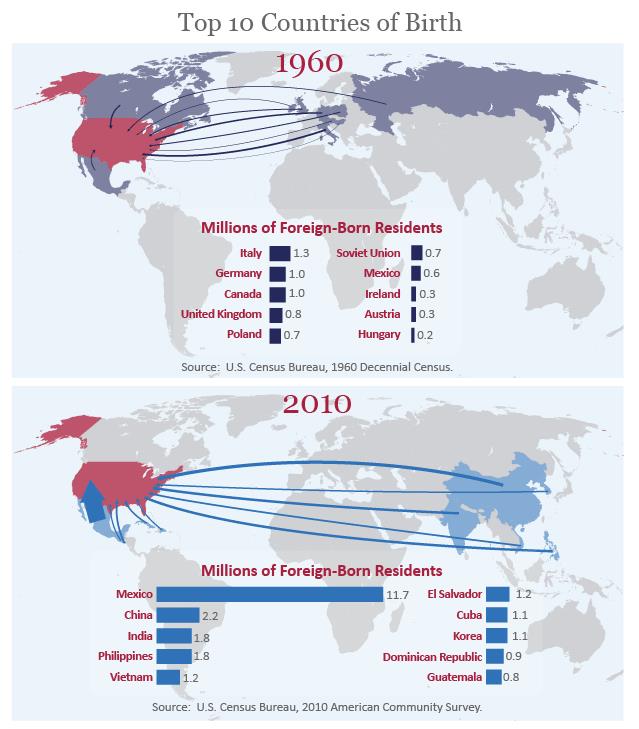
  • infographics (an example is presented in Image 1, below).
  • interactive maps.
  • audio.
  • photos.
  • publications.
  • video.
  • working papers.
  • software.
Image 1. Infographic displaying the changes in the number of foreign-born residents in the U.S. (1960 to 2010) and their native countries (Source: U.S. Census Bureau).


For this series, we will continue to use wine as our example.

Imagine that you read an article about which alcoholic beverages pair well with authentic Chinese food and you learned that Rieslings are a good choice since “they go well with Chinese cuisine because the mouth-feel is quite refreshing…the range of dry to sweet Rieslings can match all types of Chinese food, plus it’s never too heavy, but rather fresh and fruity.” Now you begin to think about:
  1. how you could inform current customers that your wines pair well with this popular cuisine (this article provides wine pairing recommendations for “Americanized Chinese” takeout – which also suggests Riesling as being an appropriate choice) and 
  2. how you could promote your Riesling to the Chinese consumers who may live in your region.
One of the first things you want to do for #2 is to learn whether there is a population of Chinese consumers in your county or metro area (and city if the population is large enough) and how many are ages 21 and older. For this example, we used the State College, PA metropolitan area as the location for learning about the existence and number of adults who responded during the 2010 Census that they were “Chinese (except Taiwanese) alone or in any combination.”

The tool we are demonstrating also allows us to search for data for “Chinese alone or in any combination” (which would include Taiwanese) and “Taiwanese alone or in any combination.” Hence, you can get fairly specific with your data requests. (The “alone or in any combination” means that the data describes those who indicated on their Census form that they were only Chinese as well as Chinese consumers who indicated that they were also of another race/ethnicity).

The abbreviated table below provides the following information: Total Chinese population (3,360 individuals in the State College, PA metropolitan area), as well as a breakdown by age range (e.g. 68.1% of these individuals were 21 and older in 2010), and the number of males who were between the ages of 20 and 24 (524 or 15.6% of the total population of Chinese).

Image 2. A portion of a table that describes the total population of Chinese (except Taiwanese) and breakdown by age range and other characteristics based on the 2010 U.S. Census.


There are many ways to build tables like the one presented for this demonstration. We simply used “metro/micro statistical area within state” and “Race and Hispanic Origin” as our search criteria and then selected the “DP-1 Profile of General Population and Housing Characteristics: 2010” (Image 3).

Image 3. Search fields and options available to create tables like that in Image 2 (From the US Census Bureau website).


One caveat is that data is only available if more than 100 individuals are in the group you are investigating. For example, with the State College metropolitan area being less populated than other metro areas in the state, there were not enough “Argentinians,” “Nicaraguans,” or others from select South American countries to create tables (though we were able to learn that at the time of the 2010 Census, there were 651 “South Americans” residing in the metro area). In contrast, data for the much larger metropolitan Philadelphia area showed that there were 2,336 Argentinians residing in this location. If there is a large population of Argentinians in your area and you want to promote a wine that will pair well with traditional “pork dishes and rich, winter-warming meat stews” then you would focus on your Cabernet Sauvignon (http://bit.ly/LjvC0R).

As you can see, the US Census Bureau website can provide a tremendous amount of demographic data for your specific target market location. Our next tool for learning about new markets is the Easy Analytic Software Inc (EASI) Demographics tool which will be discussed in the next post.

Friday, May 29, 2015

Internet Tools to Help You Learn About New Markets, Part 1

By Dr Kathy Kelley, Professor of Horticultural Marketing and Business Management, and Dana Ollendyke, Extension Associate


In the marketing world, we constantly discuss strategies to increase sales, and these conversations often focus on two options – sell more to your current customers or find new ones.

Most people would agree that it is much easier to meet current customers’ needs and demands because you already have a relationship with them. Therefore, your promotion and advertising “costs” (time and money) should be less than what you might need to acquire new customers.  For this post, we will be using wine as our example.

Imagine that you are looking for new markets to sell your wine to because:
  • your wine production volume has increased. 
  • you feel you have exhausted the local market and have done your best to attract visitors looking for a tasting room experience. 
  • and/or it is essential to investigate new opportunities.
When you first developed your tasting room business plan, you probably gave some thought as to how you would market to consumers and how you would identify potential clientele. If it has been awhile since you’ve reviewed your business plan, you will likely need to update it since your business has probably changed over the years.
 
Customers visiting a winery's tasting room (Photo credit http://bit.ly/1AyDrbl)

Perhaps you not only thought about how you would attract and meet the needs of consumers based on their generation, consumption frequency, and when they drink wine (e.g. while cooking, watching sports, at restaurants, etc), but maybe you even gave some consideration to learning about how different cultures approach wine and include (or exclude) wine from their diets.

We subscribe to several different online newsletters and journals (some of which are international) and regardless of the newsletter/journal’s origin, there is often an article about how a large brand, wine company, or group of wineries are looking to export to emerging markets. Along with providing information about current wine consumption and predictions, wine preferences, and how wine should be presented in the marketing place (cork vs. screw cap, for example), these articles discuss the population of these foreign lands in terms of growth trends, major population centers, generational distribution, major ethnic groups and races, gender breakdown, employment rate, etc. — all of which can help a business determine the viability of the market and to whom/where to market the product.

Though the goal of these articles is to provide information for targeting wine consumers, the information provided can certainly be useful for targeting consumers of any product or service based on specific racial and ethnic heritages.

But how should you begin crafting a strategy to target these consumers?
Winery tasting room owners/operators may be familiar with “who” lives in their city or county, but if you need a refresher or have never really delved into the demographic makeup of these residents, information can be found online in multiple places.

Some of our top picks include:

  • The US Census Bureau website.
  • Easy Analytic Software Inc (EASI) Demographics tool.
  • Small Business Development Center's Geographic Information Systems (GIS) reports.
We will discuss each of these tools in more detail in future posts.

Sunday, April 5, 2015

First Impressions Count – Marketing Display Techniques from the World’s Best Markets

"Pile it high and watch it fly" is a popular marketing tactic that is alive and well in some of the best international markets. This month, members of the Penn State Extension Marketing team traveled to Barcelona to participate with market professionals from 6 continents and learn from some of the most profitable markets in the world. A recent trip through many of our host city’s most famous farmers markets yields interesting merchandising techniques to start your 2015 summer market season off with a bang and hopefully a few more bucks in your pocket!


Successful marketers in Spain’s bustling market places are pairing age old techniques with bright new merchandising tricks to make their produce pop!

Here are a few tips:

1. Careful stacking is paramount! First, form a solid base. You can’t pile it high if it rolls on the floor! Start with a stair step type foundation made of boxes, plastic reusable containers that stack to transport from the farm, or simply small boxes that you packed your product in to bring to market. Next, pad your stack to create a non-slip surface. This can be done with tissue paper or organic material such as leaves. Then stack your product in a pyramid formation, depending on its shape and resilience to stacking.


2. Display vertically. Think of the vertical space on your table and make good use of it! Typically customers can reach across a table at a distance of up to 4 feet if a display is tilted at an upward sloping angle compared to only a reach of 2 feet if they are forced to reach straight across the table in order to reach your item for their shopping basket. This can be achieved by providing steep sloping stair steps behind baskets and boxes angling them so products are served directly up to the customer’s ideal height and reach.


3. Think outside the box when making display rack choices. A unique display container or shelf can stand out if you limit your number of racks or other display items. Be sure not to crowd your stand with many small shelves or racks as this tends to give an over-decorated or busy look and distracts the customer from your product.


4. Height matters in the height of the season! When produce is plentiful and you must expand outside of your primary table be sure to raise items to an ideal level for your customer. An easy way to do this is to stack crates or boxes that you used to bring your product to market. Topping them with an eye-catching basket, cloth or other material makes items placed here stand out. This technique is also useful for special items you would like to highlight for the day in addition to when you have an overflow of tomatoes or large items such as winter squash.


Whatever your product or variety throughout the year, plentiful displays, friendly smiles, consistent easy-to-read signs and a thoughtful display will get your product noticed this market season.


by Carla Snyder, Ag Entrepreneurship & Marketing Educator, Penn State Extension