Authors

Showing posts with label Marketing. Show all posts

Thursday, November 5, 2015

"Mandatory" social media platforms for agricultural businesses

By Dr Kathy Kelley, Professor of Horticultural Marketing and Business Management, and Dana Ollendyke, Extension Associate


Through an internet survey conducted by researchers at Penn State, Rutgers, Cornell, and New York University in 2013, 1,183 participants answered questions concerning their wine purchasing and consumption attitudes and behaviors and their demographic and socioeconomic status. Panelists were screened for being at least 21 years old, residing in one of the targeted mid-Atlantic states (New York, New Jersey, or Pennsylvania), and for having purchased and drank wine at least once within the previous year.

This survey may be focused on wineries, but the data collected can be of use to many agricultural business types. Marketing is an integral part of doing business.  Using social media to inform consumers about your products and events is an excellent way to build relationships.

John Gillespie, founder and CEO of Wine Opinions, a wine research company, stated in the article "Who’s Drinking Wine? A Look at the Wine Market Council’s Latest Survey" that 66% of core wine drinkers (those who drink wine at least once a week) and 40% of marginal wine drinkers (those who drink wine less frequently than once a week) use the internet to get information about wine. The article also said that more than half of all wine drinkers are on Facebook.

Consumers who participated in our internet survey were asked to select from a provided list of social media platforms they felt were mandatory for a winery to offer.  As you can see by Figure 1, Facebook is the significant front-runner.  Over 40% of participants believed that this social media tool is "mandatory" for a winery to implement.  Other platforms like Twitter, Pinterest, Instagram, and YouTube were significantly less important to respondents.

Figure 1. Social media platforms that survey respondents believed were "mandatory" for a winery to implement.


More information about the survey results can be viewed in the video series "Consumer Attitudes and Behaviors Towards Wine Purchases".

To learn more about social media marketing and the survey data, please see video 5 in the series.

As an agricultural business owner, what social media platforms do you use?  Which one(s) seems to drive the most interaction with your customers?

Friday, September 25, 2015

What Activities and Events Might Drive Customers to Your Tasting Room? Part 2

By Dr Kathy Kelley--Professor of Horticultural Marketing and Business Management, Abigail Miller--Master's student in the Penn State Plant Sciences Department, and Dana Ollendyke--Extension Associate


In part 1 of this series, we discussed survey results as to what activities and events respondents had the most interest. There are also other opportunities to make connections with local restaurants, cheese mongers, bakeries, chocolatiers, etc. For example, might one (or more) of these businesses create a small tasting plate that could be included in your “premier tasting option?” Or, could it be purchased separately for visitors to enjoy along with a glass of wine they purchase and consume at your tasting room? It is likely that some of your visitors would appreciate the opportunity to try a regional cheese with your wine.


Or, you could substitute the palate-cleansing crackers you provide to each taster with a few slices of bread from a local bakery. This is another great way to cross promote with other local businesses. While in Paris this last May, I participated in two separate tasting events at O-Chateau Wine Tasting & Wine Bar (o-chateau.com). Along with a breakdown of what my tasting fee would include (five still French wines and one Champagne, a two-hour session with an English speaking sommelier, and a private tasting room for no more than 12 participants), the description also alerted me that not only would bread be included, but that I would be tasting baguettes from the bakery that supplies items for the president of France. Though some participants might not consider this as being a benefit or anything special, others might find it appealing.


With 70.2% of our participants responding that they would be interested in visiting a winery that offered “holiday events,” consider occasions that might be a good fit with your wine. Commonly celebrated holidays such as Valentine’s Day, Thanksgiving, New Years, and religious holidays might come to mind quite easily, but don’t forget local holidays or events that may appeal to your tasting room visitors. For example, the neighborhood of Bloomfield (in Pittsburgh, PA) holds an annual Italian heritage festival called “Little Italy Days” (http://littleitalydays.com). A winery tasting room could partner with a local Italian bakery to pair wines with Italian pastries.

While a “painting party/class” and “book clubs” were of less interest to our participants, it is possible that such events and activities might still be of great interest to your visitors. As with any new marketing idea or change you make, it is essential to make sure that “it” is a good fit for your business, then trial “it,” and finally evaluate “it.”

Just a few things to think about as you plan your future winery tasting room activities and events. You may want to even consider planning an event to celebrate Wine Tourism Day on November 7th (http://www.winetourismday.org). In its third year, the day is planned to encourage wine tourism businesses, including hotels and restaurants, to offer events as a way “to celebrate the importance (and fun) of wine tourism.” Another opportunity to raise your glass and celebrate!


Additional Research & Thesis Advisory Team Members:

• Jeffrey Hyde, Professor, Agricultural Economics, The Pennsylvania State University

• Denise Gardener, Extension Enologist, Department of Food Science, The Pennsylvania State University

• Brad Rickard, Assistant Professor, Charles H. Dyson School of Applied Economics and Management, Cornell University

• Ramu Govindasamy, Professor, Department of Agricultural, Food and Resource Economics, Rutgers University

• Karl Storchmann, Clinical Professor, Economics Department, New York University; Managing Editor, Journal of Wine Economics

• Rob Crassweller, Professor, Professor of Tree Fruit, The Pennsylvania State

University


The project “Developing Wine Marketing Strategies for the Mid-Atlantic Region” (GRANT 11091317) is being funded by a USDA Federal-State Marketing Improvement Program grant, whose goal is “to assist in exploring new market opportunities for U.S. food and agricultural products and to encourage research and innovation aimed at improving the efficiency and performance of the marketing system.” For more information about the program, visit http://www.ams.usda.gov.

Friday, September 11, 2015

What Activities and Events Might Drive Customers to Your Tasting Room? Part 1

By Dr Kathy Kelley--Professor of Horticultural Marketing and Business Management, Abigail Miller-- Master's student in the Penn State Plant Sciences Department, and Dana Ollendyke-- Extension Associate


In 2014, researchers at Penn State, Rutgers, Cornell, and New York University collaborated on a wine marketing study funded by the USDA. Data were collected through a 15-minute Internet survey (22-24 October 2014). Participants residing in New Jersey, New York, and Pennsylvania were screened for not being a member of the wine industry, being at least 21 years old, and for having purchased and drank wine at least once within the previous year. A total of 977 participants qualified and completed the survey.

With approximately “81% of [Pennsylvania wine] sold directly from wineries” (http://bit.ly/1LygxFl), one of the issues we investigated in last year’s survey was what a winery could offer to encourage winery tasting room visits and increase the frequency of these visits.  While, in some cases, we investigated broad categories and factors, we have plans to delve deeper in an upcoming survey to see what could motivate consumers to visit a winery tasting room and barriers survey participants feel prevents them from visiting.

Interest in winery activities and events

Today’s visitors do much more than just taste the wine at a tasting room; rather, there are opportunities to tour the vineyard and the wine-making facility, participate in classes, attend festivals, and much more (http://bit.ly/1JtOEHK).

But should a winery go through the process of planning, implementing, and evaluating an event or activity?

Data from a study conducted by researchers at Texas A&M University and Sam Houston University showed that, for Texas wineries, there was “a positive correlation between wineries that offer services such as tasting rooms and tours and gross sales… [thus] the more tourism services a winery offers, the higher their potential for gross sales” (http://bit.ly/1NSBgRx),

OK, so, with all that could be offered – what activities and/or events might garner the greatest consumer interest?

Though not an exhaustive list, we focused on activities and events that were more commonly found when we investigated wineries online and also based on popular press articles. As an example, an event that has been offered at some wineries and restaurants is a “Paint Nite,” during which attendees paint a certain picture by following an instructor while enjoying wine or other alcoholic beverages (for example, https://www.paintnite.com/). We were interested in learning if this activity appealed to our participants, and, if so, how much. Below is a table with data pertaining to the level of interest our participants expressed based on the seven activities/events that we tested.


As you can see, “tasting events,” “tour of the winery and vineyard,” and “food vendors from local restaurants,” were the three activities that had the highest level of interest (86.3%, 83.0%, and 78.9%, respectively), and are often interdependent of each other.

It makes sense that if someone is going to visit a winery tasting room that they would be interested in tasting the wine, but there are opportunities to offer “tasting events” that go a beyond the norm – perhaps they could be based on a theme, focus on your new release, be an exclusive tasting with limited seating, or your winery tasting room could be one of the stops on a local food tour.

And, although separate categories in our survey, winery tastings and tours are a natural pairing. Most likely you already offer a tour and subsequent tasting, but can you take your standard tour and split it up into several? The goal of this strategy would be to encourage even more frequent visits.

Château Élan Winery & Resort located in Atlanta, GA offers six different tour options, five are private and one is offered on a regular basis. While all six tours end in a tasting, each is unique with a different focus (http://www.chateauelan.com). The private tours focuses on each of the following: 1) the vat room, 2) the wine making process, 3) the vineyard, 4) an experience with the wine maker, and 5) a session on other Georgia food products.


More data on winery activities and events will be discussed in part 2 of this series.


Additional Research and Thesis Advisory Team Members:


• Jeffrey Hyde, Professor, Agricultural Economics, The Pennsylvania State University


• Denise Gardener, Extension Enologist, Department of Food Science, The Pennsylvania State University


• Brad Rickard, Assistant Professor, Charles H. Dyson School of Applied Economics and Management, Cornell University


• Ramu Govindasamy, Professor, Department of Agricultural, Food and Resource Economics, Rutgers University


• Karl Storchmann, Clinical Professor, Economics Department, New York University; Managing Editor, Journal of Wine Economics


• Rob Crassweller, Professor, Professor of Tree Fruit, The Pennsylvania State


University


The project “Developing Wine Marketing Strategies for the Mid-Atlantic Region” (GRANT 11091317) is being funded by a USDA Federal-State Marketing Improvement Program grant, whose goal is “to assist in exploring new market opportunities for U.S. food and agricultural products and to encourage research and innovation aimed at improving the efficiency and performance of the marketing system.” For more information about the program, visit http://www.ams.usda.gov.

Friday, August 14, 2015

What is Cause Marketing? Part 3

By Dr Kathy Kelley, Professor of Horticultural Marketing and Business Management, and Dana Ollendyke, Extension Associate


This post will continue to outline some of the important topics to consider in deciding if a cause marketing plan is right for your business. (Post 1 and Post 2 in this series have been published in previous weeks.)

Promote that you are also accepting donations
In addition to selling a product or two where the proceeds go directly to support the cause, let customers know that they can also donate funds to the cause.  You, as the business owner, may assume that consumers would automatically understand that there is more than one way to support a cause; however, it may not occur to consumers that they can make a donation in place of making a purchase.

Involve customers in selecting the cause
Two separate strategies can be used to involve consumers in selecting the cause:
  • ask consumers to nominate a cause and then vote on the one that will receive all the donations.
  • allow consumers to choose from a group of causes that would receive the donations.
This second technique is what ONEHOPE Wine has embraced. The brand donates half of all profits to a list of causes including: Cure Alzheimer’s Disease, Support Our Veterans, Save Our Planet, and several others. Each wine is associated with a specific cause. In Image 1, you can see that half of the profits for the 2009 Santa Barbara Reserve Chardonnay helps fund research to find a cure for Alzheimer's Disease.

Image 1.  Bottle of OneHope wine that benefits research to find a cure for Alzheimer's Disease.


Involve employees
Finally, employees should be asked to do more than just collect donations or indicate what purchases support the cause.  Involve them in the process of selecting the cause and associated administration needed to support events or activities.  The more employees support the effort, the more likely they are to alert customers that your business is involved in collecting donations to help those in difficult situations.

As with any new marketing program, it is very important to DO YOUR RESEARCH to determine if this is the right path for your business. 

Friday, August 7, 2015

What is Cause Marketing? Part 2

By Dr Kathy Kelley, Professor of Horticultural Marketing and Business Management, and Dana Ollendyke, Extension Associate

The first installment in this series can be found here.
With so many local, national, and international causes already being supported by your customers’ generosity, how can you compete with them and the businesses that sponsor them?  Consider the following, which could help bolster your cause marketing program.

Make sure that the donation process is transparent  
For each dollar that you collect, you need to show how and where these funds were distributed. Consumers who do not see any progress associated with the money they donated may very well choose not to donate anymore.  Be sure to indicate on your website, in your promotional activities, and in-store that money collected helps to do great things.

Consider a cause that has a natural connection with your business  
Perhaps a member of your business has suffered from a disease that could benefit from a donation.  If this is the case, ask him or her to be the “face” of the effort. In the Wharton Business School article "To Increase Charitable Appeal to the Heart-- Not the Head", it describes how consumers are more likely to donate to a cause if “presented with a personal case of an identifiable victim” through pictures and stories, “something that purely engages the emotional system”.

For example, we can all probably think of at least one product that dons a pink ribbon in honor of breast cancer research.  One of the businesses that does so is J. Lohr Vineyards & Wines.  The winery actually began partnering with cause organizers due to a family member’s breast cancer fight.  Founder Jerry Lohr lost his wife, Carol, in 2008 and through sales of both J. Lohr Carol’s Vineyard Cabernet Sauvignon and Sauvignon Blanc, the company had a 2014 goal of “providing over 4,000 mammograms to women who would otherwise be unable to afford them”. Certainly, the cause is worthy enough, but by associating a name, story, and image of Carol Lohr, we begin to associate the brand with a real family – not just a business.

Image 1.  Screenshot of the J. Lohr Vineyards website that details their mission to provide mammograms to women in need.
blog photo 3

Or perhaps there is an environmental issue that greatly impacts your city/state/region. Sales from Crimson Pinot Noir, produced by Ata Rangi Vineyard (Martinborough, New Zealand) supports Project Crimson, “to protect and renew our spectacular red-flowering rata and pohutukawa – New Zealand’s iconic native ‘Christmas trees’.” Not only can consumers support the cause by purchasing this wine (Image 2), they can also purchase Northern Rata trees and plant them on their own property (Image 3).


Image 2.  Label showcasing the partnership with Project Crimson.
blog photo 1Image 3.  Sign advertising the sale of the rare Rata trees.blog photo 2


More considerations on creating a cause marketing program to follow in part 3 of this series!

Wednesday, July 29, 2015

What is Cause Marketing? Part 1

By Dr Kathy Kelley, Professor of Horticultural Marketing and Business Management, and Dana Ollendyke, Extension Associate

Have you seen advertisements like the one below (Image 1) where a portion of the profits benefits a charity or cause?  The official definition of cause marketing from BusinessDictionary.com is "joint funding and promotional strategy in which a firm's sales are linked (and a percentage of the sales revenue is donated) to a charity or other public cause.  However, unlike philanthropy, money spent in cause-related marketing is considered an expense is expected to show a return."
Image 1. With every purchase of this tea, Teavana will donate $1 to the Oprah Winfrey Leadership Academy Foundation.

Although profits should not be the primary reason for building a cause marketing program into your promotional plan, it is suggested that consumers “feel good” about spending their money on goods that support a cause.  In 2013, Cone Communications (a public relations and marketing agency) released their Social Impact Study.  Some interesting take-aways from that study include:
  • Over half (54%) of U.S. consumers “bought a product associated with a cause” during a 12-month period ending in fall 2013, which was a 170% increase from 1993.
  • A majority of consumers (91%) want “even more of the products and services they use to support [a] cause, and 88% want “to hear how companies are supporting social and environmental issues”.
  • If you are looking to better connect with Millennial consumers via social media, they are more likely to “use social media to engage with companies around [causes]” than the general population, 64% vs. 51%, respectively.
This data is just the beginning of your research into determining if cause marketing is right for your business.  

Our next post will focus on cause marketing program development.  


Friday, July 10, 2015

Internet Tools to Help You Learn About New Markets, Part 4

By Dr Kathy Kelley, Professor of Horticultural Marketing and Business Management, and Dana Ollendyke, Extension Associate

In our previous post, we discussed using Easy Analytic Software Inc (EASI), which allows users to more easily search Census data.  This post, which will be the final one in this series, will focus on Geographic Information Systems (GIS) reports from the Small Business Development Center (SBDC).

These reports are free of charge to prospective or existing small business owners who are receiving business-counseling services from their local SBDC Advisor.
Some of the reports include:
  • Competition maps—These maps show the location of individual competitors in relation to a small business location.
  • Competitor lists—These lists can include a competitor’s company name, location, number of employees at each location, whether the location is a competitor’s single location or branch, estimated annual sales volume, the competitor’s NAICS (North American Industry Classification System) and SIC (Standard Industrial Classification) codes and a latitude and longitude coordinate.
  • Consumer expenditure comparison reports—These reports help clients evaluate the relative demand for their chosen industry within their local market area, county, state, and the nation.
  • Drive time reports—The time it takes to travel to a local store or restaurant can be a significant factor in defining the target market for a small business. These highly detailed maps show the geographic boundaries of a small business’ target market customized to the amount of time considered acceptable to the small business’ clientele (Image 1).
Image 1. A sample Drive Time Map showing the market area that can reach a small business destination in Lakewood, CA within 10 minutes. (Contact your local SBDC for a customized map.)


Certainly, this blog series doesn’t discuss all that is needed to better understand consumers’ attitudes, behaviors, etc. towards wine based on their race and ethnicity. It does, however, provide some tools that are useful in gathering data and learning about the population of racial and ethnic groups you could serve in your community.
There are other components such as the consumer’s level of “acculturation,” which is the “cultural modification of an individual, group, or people by adapting or borrowing traits from another culture” (http://bit.ly/1xEH2NK). To demonstrate this point, we will use an example from Kathy’s family. Her sister-in-law was born in South Korea and came to the U.S. 15 years ago. As she has become more ingrained in U.S. society, some of her habits and preferences have become more “mainstream” American. Not only can food choices, etc. change over time, but as someone becomes “fully acculturated,” their language preference can change from their native language to English (http://bit.ly/1IxluaM) which could impact how you choose to promote your wine.
Another component is to search the Internet for “wine and Asian culture,” “wine and Chinese culture,” etc. to learn about wine style preferences and how wine is consumed (e.g. wine and Coke or wine cocktails). Also, don’t forget to investigate what culturally significant holidays these consumers celebrate.
Regardless, conducting adequate research is crucial when developing a realistic marketing plan. By finding out as much as possible about viable consumers, you will have a much better chance of understanding their needs and wants and hopefully gaining them as customers.

Monday, June 8, 2015

Internet Tools to Help You Learn About New Markets, Part 2

By Dr Kathy Kelley, Professor of Horticultural Marketing and Business Management, and Dana Ollendyke, Extension Associate


In our previous post, we discussed exploring new ways to market your products. We listed 3 of our favorite internet tools:
  • The US Census Bureau website.
  • Easy Analytic Software Inc (EASI) Demographics tool.
  • Small Business Development Center's Geographic Information Systems (GIS) reports.

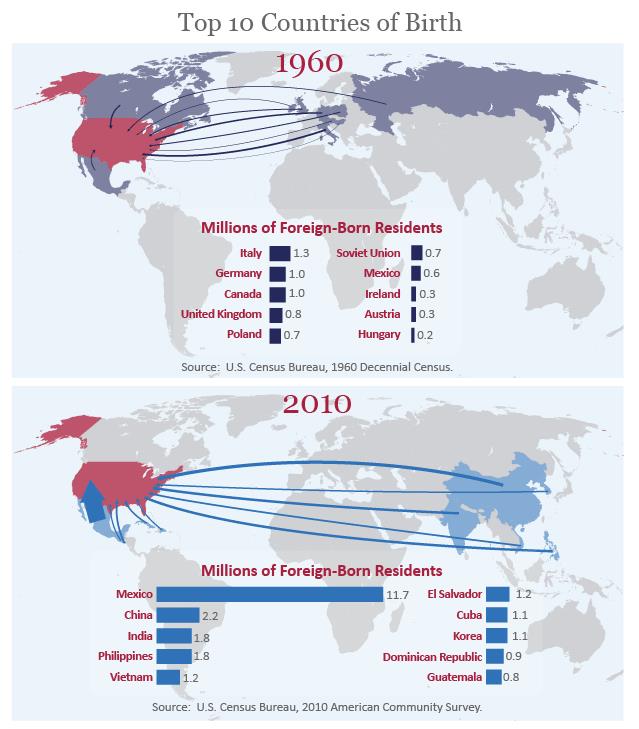
In this post, we will focus on The US Census Bureau website. Census data is presented in multiple ways including:
  • infographics (an example is presented in Image 1, below).
  • interactive maps.
  • audio.
  • photos.
  • publications.
  • video.
  • working papers.
  • software.
Image 1. Infographic displaying the changes in the number of foreign-born residents in the U.S. (1960 to 2010) and their native countries (Source: U.S. Census Bureau).


For this series, we will continue to use wine as our example.

Imagine that you read an article about which alcoholic beverages pair well with authentic Chinese food and you learned that Rieslings are a good choice since “they go well with Chinese cuisine because the mouth-feel is quite refreshing…the range of dry to sweet Rieslings can match all types of Chinese food, plus it’s never too heavy, but rather fresh and fruity.” Now you begin to think about:
  1. how you could inform current customers that your wines pair well with this popular cuisine (this article provides wine pairing recommendations for “Americanized Chinese” takeout – which also suggests Riesling as being an appropriate choice) and 
  2. how you could promote your Riesling to the Chinese consumers who may live in your region.
One of the first things you want to do for #2 is to learn whether there is a population of Chinese consumers in your county or metro area (and city if the population is large enough) and how many are ages 21 and older. For this example, we used the State College, PA metropolitan area as the location for learning about the existence and number of adults who responded during the 2010 Census that they were “Chinese (except Taiwanese) alone or in any combination.”

The tool we are demonstrating also allows us to search for data for “Chinese alone or in any combination” (which would include Taiwanese) and “Taiwanese alone or in any combination.” Hence, you can get fairly specific with your data requests. (The “alone or in any combination” means that the data describes those who indicated on their Census form that they were only Chinese as well as Chinese consumers who indicated that they were also of another race/ethnicity).

The abbreviated table below provides the following information: Total Chinese population (3,360 individuals in the State College, PA metropolitan area), as well as a breakdown by age range (e.g. 68.1% of these individuals were 21 and older in 2010), and the number of males who were between the ages of 20 and 24 (524 or 15.6% of the total population of Chinese).

Image 2. A portion of a table that describes the total population of Chinese (except Taiwanese) and breakdown by age range and other characteristics based on the 2010 U.S. Census.


There are many ways to build tables like the one presented for this demonstration. We simply used “metro/micro statistical area within state” and “Race and Hispanic Origin” as our search criteria and then selected the “DP-1 Profile of General Population and Housing Characteristics: 2010” (Image 3).

Image 3. Search fields and options available to create tables like that in Image 2 (From the US Census Bureau website).


One caveat is that data is only available if more than 100 individuals are in the group you are investigating. For example, with the State College metropolitan area being less populated than other metro areas in the state, there were not enough “Argentinians,” “Nicaraguans,” or others from select South American countries to create tables (though we were able to learn that at the time of the 2010 Census, there were 651 “South Americans” residing in the metro area). In contrast, data for the much larger metropolitan Philadelphia area showed that there were 2,336 Argentinians residing in this location. If there is a large population of Argentinians in your area and you want to promote a wine that will pair well with traditional “pork dishes and rich, winter-warming meat stews” then you would focus on your Cabernet Sauvignon (http://bit.ly/LjvC0R).

As you can see, the US Census Bureau website can provide a tremendous amount of demographic data for your specific target market location. Our next tool for learning about new markets is the Easy Analytic Software Inc (EASI) Demographics tool which will be discussed in the next post.

Friday, May 29, 2015

Internet Tools to Help You Learn About New Markets, Part 1

By Dr Kathy Kelley, Professor of Horticultural Marketing and Business Management, and Dana Ollendyke, Extension Associate


In the marketing world, we constantly discuss strategies to increase sales, and these conversations often focus on two options – sell more to your current customers or find new ones.

Most people would agree that it is much easier to meet current customers’ needs and demands because you already have a relationship with them. Therefore, your promotion and advertising “costs” (time and money) should be less than what you might need to acquire new customers.  For this post, we will be using wine as our example.

Imagine that you are looking for new markets to sell your wine to because:
  • your wine production volume has increased. 
  • you feel you have exhausted the local market and have done your best to attract visitors looking for a tasting room experience. 
  • and/or it is essential to investigate new opportunities.
When you first developed your tasting room business plan, you probably gave some thought as to how you would market to consumers and how you would identify potential clientele. If it has been awhile since you’ve reviewed your business plan, you will likely need to update it since your business has probably changed over the years.
 
Customers visiting a winery's tasting room (Photo credit http://bit.ly/1AyDrbl)

Perhaps you not only thought about how you would attract and meet the needs of consumers based on their generation, consumption frequency, and when they drink wine (e.g. while cooking, watching sports, at restaurants, etc), but maybe you even gave some consideration to learning about how different cultures approach wine and include (or exclude) wine from their diets.

We subscribe to several different online newsletters and journals (some of which are international) and regardless of the newsletter/journal’s origin, there is often an article about how a large brand, wine company, or group of wineries are looking to export to emerging markets. Along with providing information about current wine consumption and predictions, wine preferences, and how wine should be presented in the marketing place (cork vs. screw cap, for example), these articles discuss the population of these foreign lands in terms of growth trends, major population centers, generational distribution, major ethnic groups and races, gender breakdown, employment rate, etc. — all of which can help a business determine the viability of the market and to whom/where to market the product.

Though the goal of these articles is to provide information for targeting wine consumers, the information provided can certainly be useful for targeting consumers of any product or service based on specific racial and ethnic heritages.

But how should you begin crafting a strategy to target these consumers?
Winery tasting room owners/operators may be familiar with “who” lives in their city or county, but if you need a refresher or have never really delved into the demographic makeup of these residents, information can be found online in multiple places.

Some of our top picks include:

  • The US Census Bureau website.
  • Easy Analytic Software Inc (EASI) Demographics tool.
  • Small Business Development Center's Geographic Information Systems (GIS) reports.
We will discuss each of these tools in more detail in future posts.

Monday, December 29, 2014

Encouraging Consumer Purchasing, Part II

Last week I wrote about providing your customers with ideas on how your fresh and processed products can be used in ways other than their primary purpose.  This week I have a couple of more ideas that might just work for your business.

Value-added, but “light”

Processing your own value-added products (for example, processing tomatoes and other ingredients into pasta sauce, salsa, etc.) may seem overwhelming, but you do have another option for offering “meal solutions.”

What might you do if you have most, if not all, of the ingredients for salsa or pasta sauce, but you don’t feel that the private label approach (an item manufactured by another business but labeled as your own branded product) is appropriate for your business?  Or, perhaps you have an idea for a processed product and cannot find the right “finished” product offered by a private label company?

One option is to create a “light” version of a value-added product by selecting a recipe and assembling ingredients in the amounts appropriate for the recipe.  

For example, I’m sure that your customers would probably like to make your family’s award-winning salsa for their New Year’s Eve or Super Bowl party.  What you would need to do to accommodate them would be to assemble enough of each of the ingredients so that your customer would only need to refer to your recipe and prepare the salsa from all that was provided in the package.

If your recipe calls for salt and/or pepper or another pantry staple, you could omit it from the value-added light package and alert the customer that they need to add these one or two ingredients to make the dish.

What food trend does your product pair with or complement? 


Along with suggesting additional ways that your fresh and value-added products can be used as an ingredient or in a unique way, consider how you can link your goods with longstanding and/or the latest food trends.  According to a couple of sources, “fermented” foods such as kimchee and sauerkraut will gain notice in 2015.  Which of your foods would complement these dishes, or what ingredients could consumers buy from you to make their own?

Perhaps you do not make and sell your own alcoholic beverages, but your product would be a perfect pairing for a local wine, craft beer, hard cider, or even a distillery’s hard liquor (we've seen great growth in consumption - and will continue to see interest in these beverages continue).  Where can you find information as to potential pairings that you could suggest to your customers?  Here is a short list of resources:
  • Gourmetsleuth.com offers suggestions for a fair number of fresh or dried fruits, while 

    Foodrepublic.com provides an Infographic on pairing wine and vegetables.
  • WineFolly posted a wine guide that also provides a list of what prepared foods (e.g. salty foods, vegetable dishes, roasted foods, sweets). 
  • •A downloadable chart created by the Brewers Association shows what beers pair with salads and a wide variety of meat dishes, while a list of foods that pair well with hard ciders can be found here: http://www.matchingfoodandwine.com/

While these are just a few ideas, these strategies can help you provide your customers with one, two, three, or more ways to use the products you sell.  You’re really only limited by your imagination.

Thursday, July 31, 2014

Brags and Blunders!


Often the conversation amongst direct-to-consumer farm marketers can turn to “So, what are you doing that’s new and exciting?” I was fortunate to be able to hear some new and exciting ideas recently.

http://t1.gstatic.com/images?q=tbn:ANd9GcSbvxZnJi9xYiMBZFUeMAlUJ53lFrjdP2Uh0DmdtlGa2Sb7iDHyXQ
As part of our recent Are You Crazy? bus tour we had a brief session titled “brags and blunders.” The purpose of this session is for everyone to have an opportunity for describing the very best and/or the very worst marketing idea they ever implemented. This session was a great way to learn from each other and get conversations going. I relate here what I heard.


Invisible Fence Maze

Yes, they buried that invisible pet fence in a maze pattern and turned the kids loose. They did replace the buzzer with flashing lights before they started. This project was discontinued after two years. The kids had to crawl along the ground for the collars to sense the buried wire. Blunder!

Burning Fire Truck

Who doesn’t like a fire truck? Well these folks wore a big floppy foam fireperson hat and were driving around when the truck started burning. Of course, the fire extinguisher had been removed recently, so every one at the farm watched as the fire smoldered. Blunder!

Pumpkin Cannon

Have you heard about Punkin’ Chunkin’ celebrations? The one I am familiar with is in Delaware the week after Halloween. A bunch of clever folks tinker up some mechanical devices for flinging pumpkins way down the field. This marketer did the same thing, except after the season was over they decided to see how far they could send a pumpkin. After fanfare and the launch - they never did find the 1st piece of that flying fruit. Blunder!

Ground Hog Pumpkins

I don’t know about your fields, but ours can be full of ground hog living quarters. One year it seemed like most every pumpkin in this one field had ground hog damage. A few bites here and a few bites there. These folks told the touring elementary students to hunt up some of the “pumpkins with the ground hog autographs”. Well, the teachers later heard from the parents that if they were going to a farm could they at least find one that had decent pumpkins. Blunder!

Peach Smoothies

Many multi-generational farms experience family conflicts from time to time. At this roadside stand the elders did not think much at all about the new generation suggesting they start a peach smoothie enterprise. “Too much trouble!” “Who would buy that?” You might imagine the conversations. However, the younger folks persisted and today they can hardly keep up with demand for their simple and healthful recipe. Brag!

Zucchini Storm

Couple years ago when hail hit this farm they found themselves with what seemed like thousands of hail damaged zucchini. They were quite concerned if they would recover any of their production costs. Well, they advertised “zucchini storm” in all sorts of variations and sold every last fruit. Funny, but today they find it as difficult as you do to market perfectly good zucchini. Brag!


All my kitchen knives went to New York city

Many years back people were just beginning to build the NY Green Market. This country family saw the market potential but had no experience of actually being in the city. They had heard all the terrible news on how dangerous NY could be. On their very first market day at a brand new site they took every kitchen knife they owned as protection from whatever it was they might find. Today, over 20 years later they can laugh at themselves. They not only helped start the NY Green Markets movement – they continue to enjoy the experience and benefit from their efforts. Brag!


Selling butterflies

Wouldn’t you know it! Just as the potted plants in the greenhouse are ready to market an infestation of

http://bestclipartblog.com/clipart-pics/caterpillar-clipart-5.gifcaterpillars eats all the leaves and makes the remaining sticks very unattractive. Not one to let an opportunity pass, these folks decided to market the potted sticks as “buy a butterfly”. They quickly sold every last plant they had, and to this day still hear from customers what a wonderful time their families had raising their own butterflies. Brag!


“When’s the baby due?”

‘nough said. Blunder!


It goes to show – an excellent opportunity might be right around the corner, or maybe not.


For a photo series on this year's Tour, visit Are You Crazy Tour 2014

Wednesday, June 11, 2014

When Targeting Retailers Rather Than Consumers

by Winifred McGee, Extension Educator, Dauphin Co.

In our Penn State Extension Food for Profit workshops, we routinely discuss the necessity of targeting a niche market, then innovating related to that market segments' wants and needs - actually getting ahead of your customer by creating what they will want next (before it is realized by target customers).  This process takes time and research, first identifying a set of similarities that define the group, learning as much as possible about the group (observation, social media, etc.) to create a strategy to reach these customers in ways that count.  This process works well for entrepreneurs who will make the product, and make direct sales.

However, if an entrepreneur sets his or her sights on selling to retailers (the ones who actually target, and sell to consumers) the market research can get a little "murky."  A new perspective is needed to develop an effective wholesale campaign that hits home for buyers - one that replicates the targeting to actual food customers.
Being a link in the supply chain takes connections,
work and perseverance!

The SBA Blog Spot has a great article by Caron Beesley (a small business owner, a writer, and marketing communications consultant) that provides basic insights in how to become a supplier to larger retailers.  While it may be a long, uphill stretch to attract the attention of buyers and get products from your small-scale food manufacturing concern placed in a substantial retail chain, Beesley indicates that the potential rewards are substantial.  She references a study that showed that after a small supplier lands a contract from a bigger company, the small company's revenues go up 250 percent and they create about 150 percent more jobs in just two or three years.

So, how to enter this lucrative marketplace?  Like all marketing activities, the process starts with research.  Start with identifying potential buyers, and then define the value your small business can offer if they carry your product(s).  One source of information about potential wholesale buyers is the Supplier Connection.  This portal allows small suppliers (with less than $50 million in revenues, or less than 500 employees) to market themselves (free of charge!) to a number of large U.S. companies at the same time, so that the "large guys" can expand the variety of items sold, while giving capable small firms the opportunities of the large marketplace.

The Supplier Connection is relatively easy to use, with a downloadable manual to facilitate new businesses' participation.  Each participating member creates a profile to display company information, their small business commitment, usage of Supplier Connection within their company, contacts, etc.  Accessing the Supplier Connection enables small-scale food business owners to identify businesses that are the best fit for their product lines.

Most times, just being registered is not enough.  There are several social media channels that will make a business more apt to be noticed through Supplier Connection.  One of these is a Linkedin group for small business members.  In addition, Supplier Connection can be visited on Facebook, Twitter, or Google+ for news, updates and information on small business development and they have a blog that hosts a monthly contest and highlights small business success stories.  Each of these are a great way to be actively learning and launching a wholesale endeavor.

No route to launching a food business is 100% guaranteed - and there may be many barriers to break through on the way to successful wholesale marketing of a food product.  However, taking the time to get to know the "lay of the land" to successfully connect with potential customers will increase the chance of success in becoming a part of a supply chain - and getting a food product on its way to the consumer.