Authors

Wednesday, July 29, 2015

What is Cause Marketing? Part 1

By Dr Kathy Kelley, Professor of Horticultural Marketing and Business Management, and Dana Ollendyke, Extension Associate

Have you seen advertisements like the one below (Image 1) where a portion of the profits benefits a charity or cause?  The official definition of cause marketing from BusinessDictionary.com is "joint funding and promotional strategy in which a firm's sales are linked (and a percentage of the sales revenue is donated) to a charity or other public cause.  However, unlike philanthropy, money spent in cause-related marketing is considered an expense is expected to show a return."
Image 1. With every purchase of this tea, Teavana will donate $1 to the Oprah Winfrey Leadership Academy Foundation.

Although profits should not be the primary reason for building a cause marketing program into your promotional plan, it is suggested that consumers “feel good” about spending their money on goods that support a cause.  In 2013, Cone Communications (a public relations and marketing agency) released their Social Impact Study.  Some interesting take-aways from that study include:
  • Over half (54%) of U.S. consumers “bought a product associated with a cause” during a 12-month period ending in fall 2013, which was a 170% increase from 1993.
  • A majority of consumers (91%) want “even more of the products and services they use to support [a] cause, and 88% want “to hear how companies are supporting social and environmental issues”.
  • If you are looking to better connect with Millennial consumers via social media, they are more likely to “use social media to engage with companies around [causes]” than the general population, 64% vs. 51%, respectively.
This data is just the beginning of your research into determining if cause marketing is right for your business.  

Our next post will focus on cause marketing program development.  


Tuesday, July 14, 2015

Crowdfunding: An Exciting New Way to Fund a Project


By Juliette Enfield, Penn State Extension Educator, Warren Co.

The success of any business depends on the crowd that supports it.
Crowdfunding captures the essence of the entrepreneurial spirit-that anything is possible. The size and scope of the projects on crowdfunding sites are awe inspiring. In 2012, the JOBS –Jumpstart Our Business Startups Act was passed by Congress and signed into law by the Obama Administration.  This Act eliminated certain restrictions on how new startup businesses could be funded. Since 2012, crowdfunding has become a term that many people are familiar with, but may not have direct experience with. Have you ever considered crowdfunding for your business? Perhaps you are uncomfortable with the high interest rates that may be incurred with a loan, or maybe your credit isn’t the best and you are unable to access a loan in the first place. Crowdfunding can work in a few different ways. Investors can support a new business by buying a share in the business (equity crowdfunding), making donations (donation crowdfunding), or lending money (debt crowdfunding). According to Forbes.com, there are over 500 crowdfunding platforms online, so even if you understand the basic fundamentals of how crowdfunding works, you will need to do some research to find a site that will work well for you. Some sites have stronger reputations than others, and some have easier access to customer service. Also, many crowdfunding sites specialize in a certain type of project or industry. For example, Quirky specializes in funding inventions of new everyday tools, Crowdrise specializes in charitable projects, and GiveForward specializes in funding medical expenses for people will illness. Another difference among crowdfunding sites is how and when payments are received for a project. For example, Kickstarter only accepts payments from investors if the project has been funded, and Indiegogo accepts payments from investors regardless of whether or not a certain goal has been reached. Crowdfunding sites charge a fee ranging from 7-12% of the total project cost, so this may also influence your decision of which platform to use.


Crowdfunding for Farm and Food Businesses

Birchrun Hills Farm, a dairy farm and cheese business in Chester County, PA successfully funded a project to build a new cheese cave on Kickstarter. Kickstarter is a popular donation based crowdfunding website. Kickstarter projects include film, music, art, design, technology, and food. I spoke with Sue Miller, Birchrun Hills Farm business owner, about her experience with Kickstarter. She chose Kickstarter because of the recognition of the site, she liked the all or nothing philosophy of the site, and the fees were reasonable. She also knew of other farm businesses that had success with the site, including North Mountain Pastures in Newport, PA, a meat CSA farm with a charcuterie business. Sue ran a 30 day campaign in December 2014. For different donation levels, Sue offered a variety of different prizes ranging from a hat with the farm logo on it to private cheese and beverage pairing parties. She said the most popular prize she offered was the chance to name a newborn calf on the farm. Sue estimated that less than 5% of the people that were reached about the campaign actually donated. Therefore, the campaign period is an intense marketing time, and having a marketing strategy and a budget in place is essential. Sue said she was delighted to see how the community supported her project, and now that the campaign is over and she is building her new cheese cave, crowdfunding has helped her expand her business network in the region and across the nation. For those thinking about embarking on a crowdfunding endeavor,  Sue recommend that they work for a year or so prior to the campaign period to expand their social media network, since this is the primary way crowdfunding campaigns are advertised. She also said that next time she might consider hiring someone to run the campaign for her, so that she would not have to run the farm and the campaign at the same time. You can still view Sue’s campaign on Kickstarter.

What would you like to do next with your business?

Another crowdfunding site that agricultural businesses should know about is Kiva Zip. Kiva Zip is a debt based crowdfunding site that offers 0% interest loans to funded projects. Kiva was first created to help finance microloans to farmers and small businesses in developing countries, but it has recently grown in popularity in the US with small and beginning farmers. Kiva loans are especially well adapted to new farm and food businesses because the loans are small, from $5,000 to $10,000, and are therefore less risky. Once the money is lent, the business has 3 years to repay the loan. The Kiva fundraising process has three tiers. First, the agricultural businesses must be endorsed by a Trustee, a business or an individual (non-family member) that will vouch for the character of a borrower. Then, once the Trustee is in place, a network of friends and family (ranging from 10-30 contacts) must be the primary lenders to the project. This occurs during the first 15 days that the campaign is launched. And finally, after this primary network has lent to the project, the project is opened for anyone to lend. Kiva projects are live for 45 days. Emily Keebler, Kiva City Pittsburgh Lead, says that the first 15 days of fundraising is the most intense fundraising period. Emily says that many businesses that have a successful lending experience with Kiva Zip then become Trustees themselves for another business, and these small amounts of money continue to support small businesses over and over again. Healcrest Urban Farms, a farm that grows herbs and small fruits in Pittsburgh, PA successfully received a loan on Kiva Zip to pay for the use of a shared kitchen and purchase of an ice cream cart to start their popsicle business, TeaPops. Good Work Farms, LLC, a vegetable farm in Emmaus, PA received a loan on Kiva Zip to purchase draft horses for plowing and lowering energy costs on their farm. BEEBOY Honey, a beekeeper in Pittsburgh received a loan to purchase more hives and a truck for honey deliveries. Kiva Zip may be an option for your food business if you decide that offering rewards for donations may be too much of a challenge and you would rather spend your time and energy repaying a small loan.

Be sure to do your research before choosing your crowdfunding platform. Spend time looking at the projects that are out there. Create a budget, marketing plan, and a clear, concise message about what you are trying to accomplish. Have you had any experience with crowdfunding? Share your comments and suggestions with us!

Sources for this blog:

Caldbeck, Ryan. Crowdfunding Trends: Which Crowdfunding Sites Will Survive. Forbes.com. June 23, 2013. <http://www.forbes.com/sites/ryancaldbeck/2013/06/23/crowdfunding-trends-which-crowdfunding-sites-will-survive> Accessed July 8, 2015.

North Carolina State University Cooperative Extension. Funding Opportunities. June 2014. <http://communitydevelopment.ces.ncsu.edu/funding-opportunities>  Accessed July 8, 2015.

Pollack, Bridget. The Ins and Outs of Alternative Financing. U.S. Small Business Administration Blog. June 4, 2015. <https://www.sba.gov/blogs/ins-and-outs-alternative-financing>Accessed July 8, 2015.

Friday, July 10, 2015

Internet Tools to Help You Learn About New Markets, Part 4

By Dr Kathy Kelley, Professor of Horticultural Marketing and Business Management, and Dana Ollendyke, Extension Associate

In our previous post, we discussed using Easy Analytic Software Inc (EASI), which allows users to more easily search Census data.  This post, which will be the final one in this series, will focus on Geographic Information Systems (GIS) reports from the Small Business Development Center (SBDC).

These reports are free of charge to prospective or existing small business owners who are receiving business-counseling services from their local SBDC Advisor.
Some of the reports include:
  • Competition maps—These maps show the location of individual competitors in relation to a small business location.
  • Competitor lists—These lists can include a competitor’s company name, location, number of employees at each location, whether the location is a competitor’s single location or branch, estimated annual sales volume, the competitor’s NAICS (North American Industry Classification System) and SIC (Standard Industrial Classification) codes and a latitude and longitude coordinate.
  • Consumer expenditure comparison reports—These reports help clients evaluate the relative demand for their chosen industry within their local market area, county, state, and the nation.
  • Drive time reports—The time it takes to travel to a local store or restaurant can be a significant factor in defining the target market for a small business. These highly detailed maps show the geographic boundaries of a small business’ target market customized to the amount of time considered acceptable to the small business’ clientele (Image 1).
Image 1. A sample Drive Time Map showing the market area that can reach a small business destination in Lakewood, CA within 10 minutes. (Contact your local SBDC for a customized map.)


Certainly, this blog series doesn’t discuss all that is needed to better understand consumers’ attitudes, behaviors, etc. towards wine based on their race and ethnicity. It does, however, provide some tools that are useful in gathering data and learning about the population of racial and ethnic groups you could serve in your community.
There are other components such as the consumer’s level of “acculturation,” which is the “cultural modification of an individual, group, or people by adapting or borrowing traits from another culture” (http://bit.ly/1xEH2NK). To demonstrate this point, we will use an example from Kathy’s family. Her sister-in-law was born in South Korea and came to the U.S. 15 years ago. As she has become more ingrained in U.S. society, some of her habits and preferences have become more “mainstream” American. Not only can food choices, etc. change over time, but as someone becomes “fully acculturated,” their language preference can change from their native language to English (http://bit.ly/1IxluaM) which could impact how you choose to promote your wine.
Another component is to search the Internet for “wine and Asian culture,” “wine and Chinese culture,” etc. to learn about wine style preferences and how wine is consumed (e.g. wine and Coke or wine cocktails). Also, don’t forget to investigate what culturally significant holidays these consumers celebrate.
Regardless, conducting adequate research is crucial when developing a realistic marketing plan. By finding out as much as possible about viable consumers, you will have a much better chance of understanding their needs and wants and hopefully gaining them as customers.

Friday, June 26, 2015

Internet Tools to Help You Learn About New Markets, Part 3

By Dr Kathy Kelley, Professor of Horticultural Marketing and Business Management, and Dana Ollendyke, Extension Associate


In our previous post, we discussed using the US Census Bureau website to obtain demographic data for your specific target market location.  Unfortunately, the U.S. Census data can be overwhelming to search through (we admit that it took us a while to find, figure out how to develop the tables, and make changes), so you may want to access other tools that make the Census data more “user friendly.” Easy Analytic Software Inc (EASI) is an example of one of the tools that we often use to obtain consumer demographic information. EASI provides both paid and free options that allow users to more easily search Census data (instructions for navigating to the free tools can be found here).

Image 1 shows how we created a “Free Complete Report & Analysis.” There are many report options (like population by ethnic race, age, sex, etc.) and this one will give you more information that you may need, but you’ll see in Image 2 that it provides a nice breakdown of population by country of origin. We often use the EASI Ring Study as it provides data based on radiuses you select (we used 10, 30, and 50 miles) from an address you provide (we used a Harrisburg, PA address for this example).
Image 1. Criteria used (address and three radiuses) to create a Free Complete Report & Analysis. Click the “Locate!” button after you enter the address in box 1. Then click “Create Site Study” to access the data you requested.


Image 2. Data at the top of this report provides descriptive statistics of the population density, population, and households by year (including projected growth) within 10, 30, and 50 miles from the address used. The comprehensive report also provides population data of those who were of Asian Indian, Bangladeshi, Cambodian, etc. ancestry and who resided within the three radiuses (Image 3).


Image 3. Continuation of report in Image 2.  Population data of those who were of Asian Indian, Bangladeshi, Cambodian, etc. ancestry and who resided within the three radiuses.


These are just a few examples of the many reports EASI can generate for you.  Check out the website to see more detailed demographic information.  Our next tool for learning about new markets is the Geographic Informations Systems (GIS) tool offered by the SBDC which will be discussed in the next post.


Monday, June 8, 2015

You are what you eat and so is your community. Do you have access to nutritious local foods?


Internet Tools to Help You Learn About New Markets, Part 2

By Dr Kathy Kelley, Professor of Horticultural Marketing and Business Management, and Dana Ollendyke, Extension Associate


In our previous post, we discussed exploring new ways to market your products. We listed 3 of our favorite internet tools:
  • The US Census Bureau website.
  • Easy Analytic Software Inc (EASI) Demographics tool.
  • Small Business Development Center's Geographic Information Systems (GIS) reports.

In this post, we will focus on The US Census Bureau website. Census data is presented in multiple ways including:
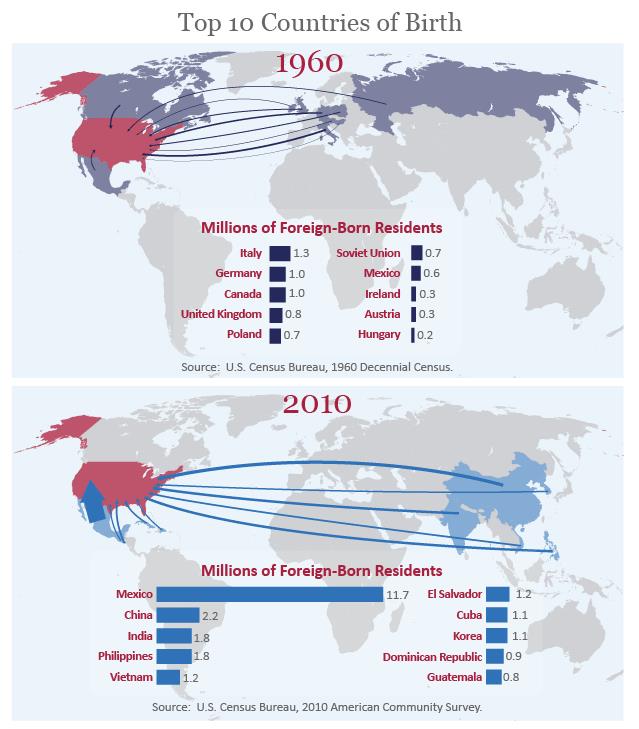
  • infographics (an example is presented in Image 1, below).
  • interactive maps.
  • audio.
  • photos.
  • publications.
  • video.
  • working papers.
  • software.
Image 1. Infographic displaying the changes in the number of foreign-born residents in the U.S. (1960 to 2010) and their native countries (Source: U.S. Census Bureau).


For this series, we will continue to use wine as our example.

Imagine that you read an article about which alcoholic beverages pair well with authentic Chinese food and you learned that Rieslings are a good choice since “they go well with Chinese cuisine because the mouth-feel is quite refreshing…the range of dry to sweet Rieslings can match all types of Chinese food, plus it’s never too heavy, but rather fresh and fruity.” Now you begin to think about:
  1. how you could inform current customers that your wines pair well with this popular cuisine (this article provides wine pairing recommendations for “Americanized Chinese” takeout – which also suggests Riesling as being an appropriate choice) and 
  2. how you could promote your Riesling to the Chinese consumers who may live in your region.
One of the first things you want to do for #2 is to learn whether there is a population of Chinese consumers in your county or metro area (and city if the population is large enough) and how many are ages 21 and older. For this example, we used the State College, PA metropolitan area as the location for learning about the existence and number of adults who responded during the 2010 Census that they were “Chinese (except Taiwanese) alone or in any combination.”

The tool we are demonstrating also allows us to search for data for “Chinese alone or in any combination” (which would include Taiwanese) and “Taiwanese alone or in any combination.” Hence, you can get fairly specific with your data requests. (The “alone or in any combination” means that the data describes those who indicated on their Census form that they were only Chinese as well as Chinese consumers who indicated that they were also of another race/ethnicity).

The abbreviated table below provides the following information: Total Chinese population (3,360 individuals in the State College, PA metropolitan area), as well as a breakdown by age range (e.g. 68.1% of these individuals were 21 and older in 2010), and the number of males who were between the ages of 20 and 24 (524 or 15.6% of the total population of Chinese).

Image 2. A portion of a table that describes the total population of Chinese (except Taiwanese) and breakdown by age range and other characteristics based on the 2010 U.S. Census.


There are many ways to build tables like the one presented for this demonstration. We simply used “metro/micro statistical area within state” and “Race and Hispanic Origin” as our search criteria and then selected the “DP-1 Profile of General Population and Housing Characteristics: 2010” (Image 3).

Image 3. Search fields and options available to create tables like that in Image 2 (From the US Census Bureau website).


One caveat is that data is only available if more than 100 individuals are in the group you are investigating. For example, with the State College metropolitan area being less populated than other metro areas in the state, there were not enough “Argentinians,” “Nicaraguans,” or others from select South American countries to create tables (though we were able to learn that at the time of the 2010 Census, there were 651 “South Americans” residing in the metro area). In contrast, data for the much larger metropolitan Philadelphia area showed that there were 2,336 Argentinians residing in this location. If there is a large population of Argentinians in your area and you want to promote a wine that will pair well with traditional “pork dishes and rich, winter-warming meat stews” then you would focus on your Cabernet Sauvignon (http://bit.ly/LjvC0R).

As you can see, the US Census Bureau website can provide a tremendous amount of demographic data for your specific target market location. Our next tool for learning about new markets is the Easy Analytic Software Inc (EASI) Demographics tool which will be discussed in the next post.

Tuesday, June 2, 2015

Reinventing the Public Market

Reinventing the Public Market
Concepcio Market
In March of 2015, the Project for Public Spaces held their international conference on pubic markets in Barcelona, Spain, one of the foremost capitals for public markets in the world. There are 40 markets in Barcelona attracting 62 million visits annually with an economic activity equivalent to 950 million euros.

However, Barcelona’s market scene was not always so bustling.  Inadequate commercial real estate, declining customers, and poor investments lead to a deterioration of market buildings and the market economy by the end of the 1980’s. In the early 1990’s, city council decided to reinvest in their city’s markets and renovate multiple locations. In 1992, the Barcelona Institute of Municipal markets (IMMB) was founded with a goal of local commerce as an economic driver to revitalize the markets and create jobs.

Working with local authorities and retailers, IMMB put together a strategic plan that set a goal for 2025 that will integrate the markets into their neighborhoods, becoming social assets and creating positive experiences for shopping and leisure with the foundation of the plan being “renovation, adaptation, innovation and promotion.”

Public-private partnership is key in the renaissance of these markets, but what else can we take from the success of Barcelona’s markets?  Pennsylvania is poised to adapt our public markets in a way that could make them a center piece for economic development to create jobs, support the development of entrepreneurial enterprises and sustain existing businesses.  

Both Barcelona and Pennsylvania have market structures dating back into the 19th century. Both are made of a mix of diverse products. Both create a public space where local residents can interact.

Many midsize cities and towns in Pennsylvania have a public market of some kind and Pennsylvania ranks third in the nation in direct to consumer market sales.  In addition, the local food movement has led to an explosion of farmers markets and value-added, artisan food producers in our state. However, many of our public markets have not enjoyed the same success.

Perhaps our markets can also thrive and remain relevant in our communities if we borrow a few founding principles that Barcelona used to revitalize their market economy. 

Renovation
What are some basic steps that can be taken to improve the appearance of our markets? Is the exterior inviting us to step inside the market? Are windows clean? Do we need to upgrade or have more modern conveniences? Do we have Wi-Fi, benches or seating? If people are comfortable enough to stay awhile, they usually spend more money. Is there easy access for everyone? Is there parking?  We want to have an inviting, functional and attractive market space for both retailers and customers.

Adaptation
Markets should reflect the needs of the communities they serve. What are the demographics of the community where your market is located? Is the vendor makeup and product offering reflective what the neighborhood would like to purchase? Is the community mostly young or seniors? What is the average household income?

More and more consumers want to know where their food is coming from and how it was produced. Can our vendors offer and promote that information?

Innovation
To keep our markets thriving and relevant we may need to attract the next generation of customers and they are the “millennials”. Millennials want “authentic” products. They also want an “experience” and a story behind their purchase. What experiences can we offer as a market place that will keep them (and others) coming back to the market as a destination for the community?

Promotion
We have so many ways to promote our markets that it can be challenging and feel a bit over whelming but if we understand who our customers are then we can target them directly using the media they consume. If the communities we are trying to attract are younger, then placing ads in print media might not be the best use of our advertising dollar since the majority of  younger consumers are using social media as their primary media for gathering information. Think about where the market is promoted, what is the demographic we are trying to attract, and do we think that our marketing efforts will reach them.  

Market managers who presented at the conference in Barcelona had some specific recommendations for keeping your market thriving and relevant.
  1. Develop a set of core values.  Example:
    1. Uniqueness
    2. Quality
    3. Diversity
    4. History
    5. inspiration
  2. Know the demographics.
    1. Age
    2. Gender
    3. Ethnicity
    4. Shopping trends
  3. Develop a whole market experience
    1. Quality products
    2. Exciting place to visit
    3. Create a market identity
    4. Offer options
Following these principals can help 19th century markets be relevant and vibrant 21st century markets.

Brian Moyer
Program Assistant
Penn State Extension
Lehigh County

Carla Snyder
Educator
Penn State Extension
Adams County